
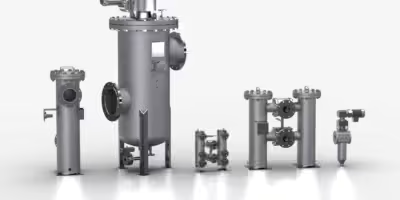

What is filter element performance rating?
Filter rating indicates the smallest particle size (in microns, μm) that a filter can capture. Several types of ratings are used, as indicated below.
To help you make the right choice instantly, here is a quick breakdown of how nominal, absolute, and beta ratings compare in efficiency and real-world use:
| Rating Type | Efficiency Level | How It Is Measured | Best Used For |
| Nominal | ~50% to 95% (Approximate) | Retains a percentage of particles | Low-cost pre-filtration |
| Absolute | 98.7% to 99.9% (Strict) | Largest particle that can pass | Critical final polishing |
| Beta (β) | Up to 99.99% (Multi-Pass) | Upstream vs. downstream count | High-precision hydraulics |
Nominal rating
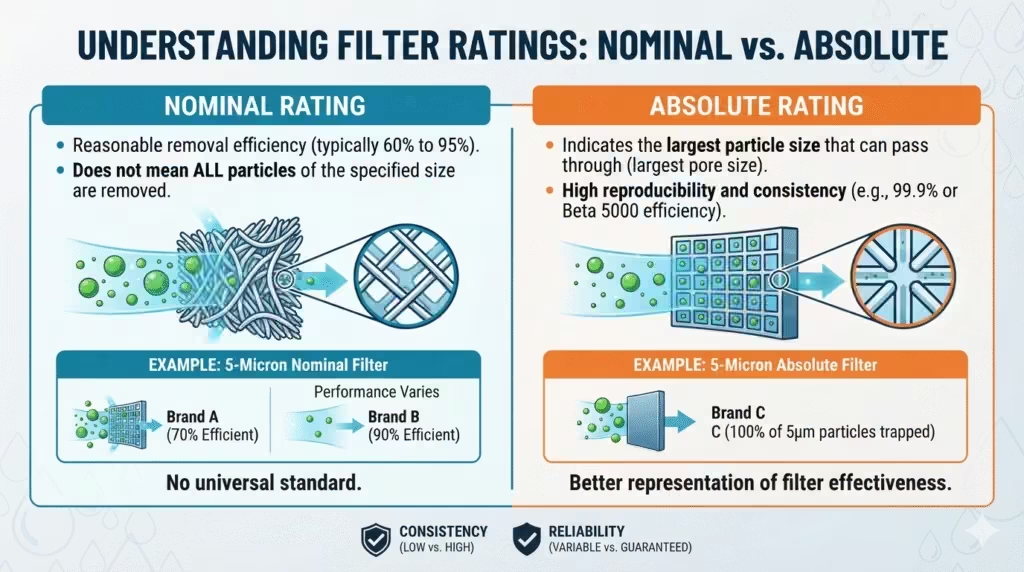
A nominal filter rating indicates the particle size that a filter can remove with a reasonable efficiency. It does not mean that all particles of the specified size will be retained. The reasonable efficiency stated earlier varies between 60% and 95% depending upon the manufacturer, as there is no universal standard for nominal ratings.
So, for the same nominal rating, say the filtration performance may be better or worse. For example, two manufacturers may both offer a 5-micron nominal filter, but one may remove 70% of 5-micron particles while the other may remove 90%.
Absolute rating
The absolute filter rating is the size of the largest spherical glass particle that can pass through a filter under specified test conditions. It is expressed in microns (µm), where 1 micron is one-millionth of a meter.
The absolute rating is based on the pore size of the filter media. If all the pores in the filter are of the same size, the filter can have a well-defined absolute rating.
However, in actual applications, filter media do not have perfectly uniform pores. The pore size can vary depending on the filter material and manufacturing process. Also, the shape of a contaminant affects whether it passes through the filter. For example, a long or needle-shaped particle may pass through an opening smaller than its largest dimension.
For this reason, some engineers consider the term absolute rating to be ideal rather than absolute in real operating conditions. It should be understood as the filter’s performance under standard test conditions, not a guarantee that no larger particle
Beta rating (Beta Ratio)
Beta ratings have become the most commonly used rating. ISO 16889 is used to determine the Beta ratio (βx) and filtration efficiency.
The Beta ratio (for a particular particle size) is the ratio of the number of particles of that indicated particular size upstream of the filter divided by the number of particles of that particular size downstream of the filter.
β_{x}= \frac{Number of particles upstream}{Number of particles downstream}For example:
Upstream: 10,000 particles (10 µm)
Downstream: 50 particles (10 µm)
Beta ratio:
β_{10}= \frac{10000}{50}=200Once you get the Beta ratio, you can calculate the filtration efficiency
η=(\frac{βx-1}{βx})×100For β = 200, the efficiency is ((200-1)/200)*100= 99.5%.
η=(\frac{200-1}{200})×100= 99.5\text{\%}
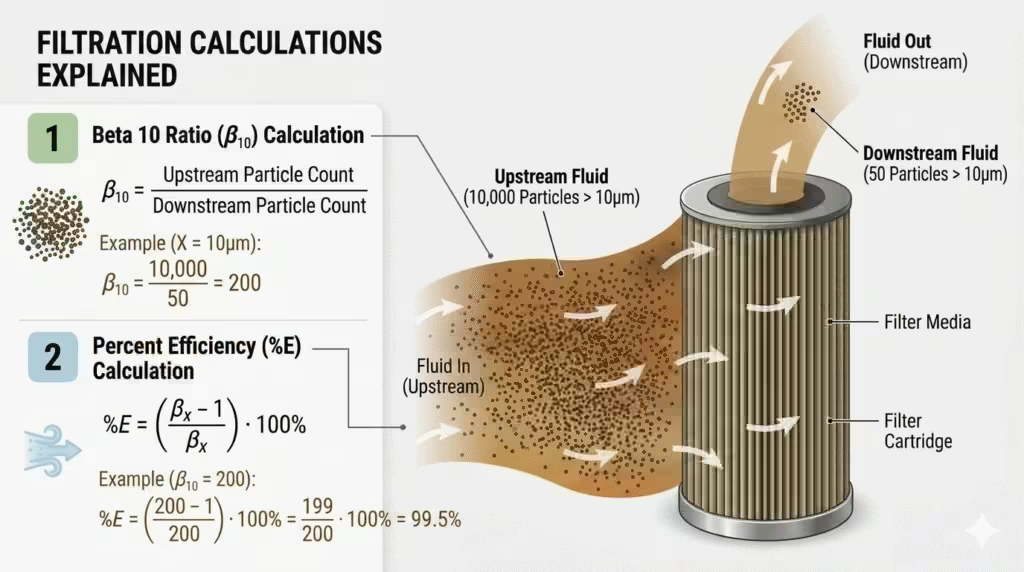
The higher the Beta ratio, the more particles the filter can retain. For example, a Beta ratio of 20 means 95.0 % efficiency, whereas a Beta ratio of 200 means the filter captures about 99.5% of particles of the specified size.
A filter with a beta of 200 at five microns is thus said to be 99.5 per cent efficient at removing particles five microns and larger.
Understanding βx(c) in Filter Testing
In βx(c) ,
β (Beta) = The filtration ratio. It tells you how many particles are stopped compared to how many get through.
x = The particle size in microns (µm) at which the test is done. Example: β10 means the filter is tested for particles ≥10 µm.
(c) = “Cumulative” or “corrected” Beta ratio, defined by ISO 16889 multi-pass test. ISO 16889 introduced the “(c)” suffix to distinguish modern, statistically valid test results from older Beta ratings. It ensures the efficiency value is based on cumulative particle counts and confidence limits, not just instantaneous readings.
The difference between Instantaneous and Cumulative Particle Count is provided below.
Instantaneous Particle Count-This is a snapshot measurement. Particle counts upstream and downstream are taken at a single moment in the test, and the Beta ratio is calculated from that one reading. The drawback is that results can fluctuate due to flow changes, dirt loading, or test noise, making them less reliable and not repeatable across labs.
Cumulative Particle Count (the “c” in βx(c)) This is the total number of particles measured over the entire duration of the ISO 16889 multipass test. Counts are continuously collected and summed, then used to calculate the Beta ratio. The benefit is that it smooths out fluctuations and provides statistically valid, repeatable efficiency values. That’s why modern datasheets always show βx(c) — it’s the ISO‑standard way.
Example
Instantaneous: At one moment, upstream has 2000 particles ≥10 µm, downstream has 1 → β10 = 2000.
Cumulative: Over the whole test, upstream had 2,000,000 particles ≥10 µm, downstream had 1000 → β10(c) = 2000.
Both give the same ratio, but the cumulative method is more reliable because it averages across the entire test.
Choosing Between Nominal, Absolute, and Beta Filter Ratings
In most industrial applications, a nominal filter rating is sufficient where the objective is to reduce contamination and protect general equipment rather than achieve precise particle removal. It is commonly preferred for cooling water systems, service water, fuel oil, lube oil, chemical transfer lines, and other non-critical process applications where a small variation in filtration efficiency is acceptable. An absolute filter rating is preferred when downstream equipment is sensitive to contamination or when consistent particle retention is required. Typical applications include hydraulic and lubrication systems, gas turbines, compressors, instrumentation, pharmaceutical processes, food and beverage production, semiconductor manufacturing, and final product filtration.
For critical applications, specifying only the nominal or absolute micron rating is often not sufficient. The Beta (β) rating is the preferred method because it defines the filtration efficiency at a given particle size and allows filters from different manufacturers to be compared on the same basis. Therefore, in industries such as power generation, aerospace, hydraulic systems, and high-performance lubrication systems, filter specifications are commonly based on the Beta ratio along with the micron rating. In general, use a nominal rating for non-critical filtration, an absolute rating where consistent filtration is required, and a Beta rating whenever filtration performance must be accurately specified and verified.

Leave a Reply