
In this article, we will see how we can select a filter when we know the requirements.
We will try to find a filter for hydraulic oil for a small processing unit.
STEP 1: Selecting a Filter catalogue or vendor
Select a renowned filter vendor that has a good reputation for quality as well as can supply the unit to the region you need. You might check if they are also good at providing any aftermarket services in the region of installation. Short the total vendor list to a few, like 2 or 3, and then you have to go through each catalogue or find the information from their designated salesperson.
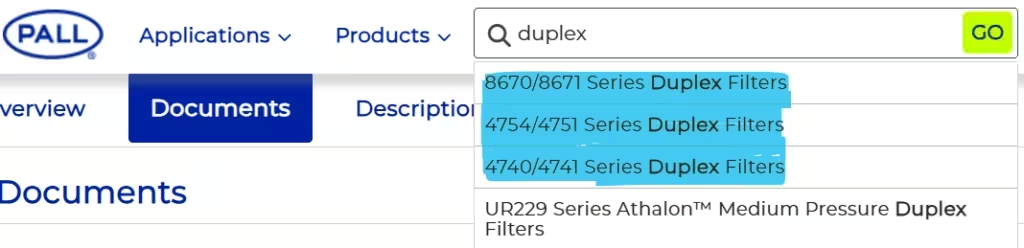
For this article, I am selecting the Pall filter catalogue. Pall is renowned, and there were some Pall filters that were used previously in the plant. I know that I need a duplex filter as per the technical specification. So, upon searching their website, we came across 3 filter datasheets per below image.
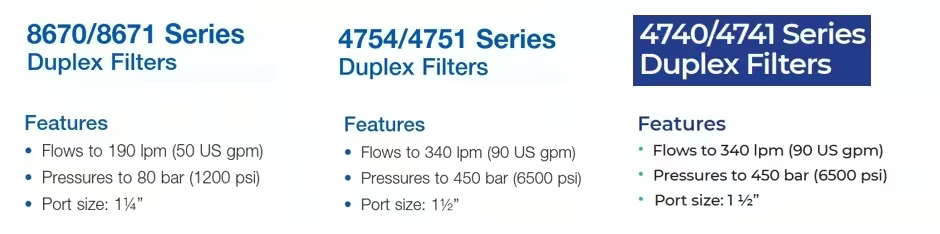
Verify flow rate, pressure and port size
Among the above, the 8670/8671series having pressure rating of 80 bars, whereas our filter requires 90 bar. So, it is not considered. Among the rest, the 4754/4751 vs the 4740/4741 series, the major difference is that the 1st one’s filter element is removed from the top and connections are SAE straight thread vs the latter one, where the filter element is removed from below and has BSP thread or split flange ports.
We know from the layout that our layout can easily provide space for a filter with top removal element rather than a bottom removal element. So the 4754/4751 is finalized for next steps after verifying the flowrate this model provides, 340 lpm is sufficient for what is required that is 60 lpm for our process.
STEP 2: Suitability of the filter element with the process fluid
The filter elements can be manufactured from a variety of materials like cellulose (paper), glass microfiber, stainless steel wire mesh, sintered metal, nylon, polyester, polypropylene, PTFE (Teflon), and other synthetic fibres. an in-compatible filter media can swell, soften, crack and fail, affecting the filtration. So the engineer has to verify the same.
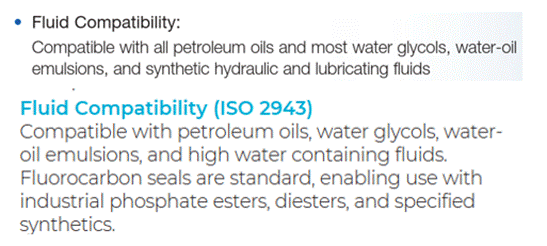
ISO 2943 is the primary international standard used to verify the compatibility of hydraulic filter element materials with the operating fluid. For chemical process applications, however, there is no equivalent universal standard. Manufacturers generally establish compatibility through laboratory testing and publish the results in their chemical compatibility charts and product dustsheets.
The process fluid in this case is mineral lube oil. And the statement below from the filter dustsheet proves the compatibility with it.
STEP 3: Filter element performance rating
Filter rating indicates the smallest particle size (in microns, μm) that a filter can capture. Several types of ratings are followed. To know about filtration rating, please click here.
In our process, the information per the spec is that we need a β₁₀>10 rating as minimum. For 9601, it is given in the catalogue that code HS is β12>2000. This is for 12-micron particles; it is 99.95% efficient. But since there is nothing rated with 10-micron in the catalogue, we communicated with the vendor, and they specified that for the filter performance code HS they can provide a β₁₀>200, which is 10-micron particle; it is 99.5% efficient. This satisfies our spec requirement, so HS is selected.
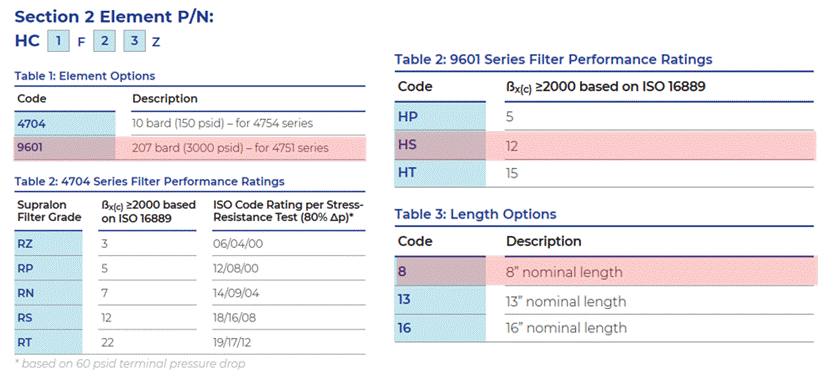
Filter element length 8” is selected per layout space available.
STEP 4: Filter element collapsing pressure
What is collapsing pressure?
Collapsing pressure is the maximum differential pressure a filter element can withstand without getting damaged or collapsing. If the pressure difference across the filter becomes too high, the element may collapse and stop working properly. Therefore, the filter element should be selected for the maximum differential pressure expected in the system.
In our process, the information per the spec is that the element collapse pressure should be a minimum of 5 bar (70 psi). But due to the margin and as the batter collapsing element is preferred, we selected 9601 with 201 bar over the 4704 element -10 bar collapse pressure.
STEP 5: Filter housing selection
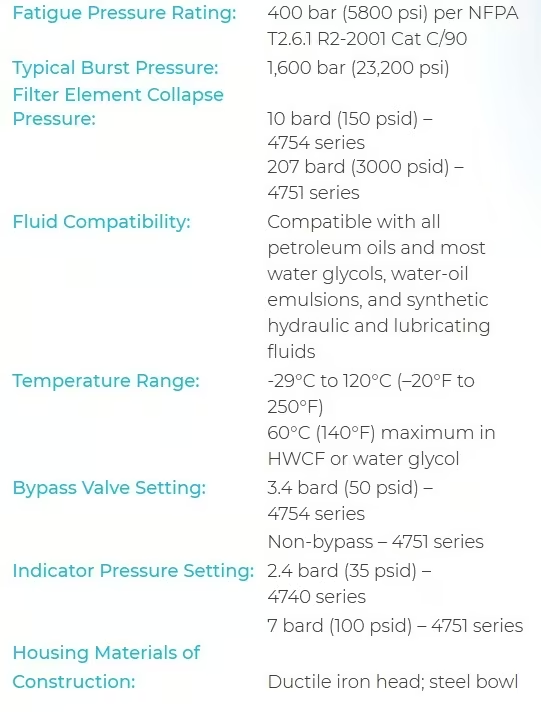
One important factor in selecting the housing is the burst pressure, and the engineer has to verify if the burst pressure is high above the normal operating pressure.
What is burst pressure?
Burst pressure is the pressure at which the filter housing may fail or rupture due to excessive internal pressure. It is much higher than the normal operating pressure. Therefore, the filter housing should be selected so that its burst pressure is higher than the maximum pressure expected in the system.
Coming back to the filter housing, we can now select the 4751 series for high collapse. Per the port connection preferred, we selected A24: 1.5” SAE J54 straight thread. Length S: 8.00”, same as the filter element length.
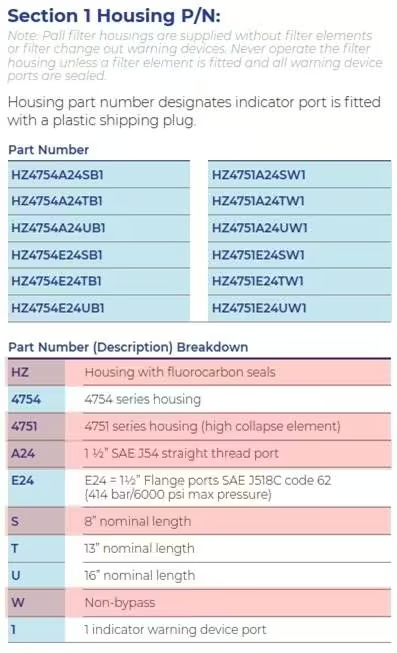
This filter has bypass valve options. When a filter element becomes clogged or loaded with dirt, the pressure drop across the element rises. If this differential pressure exceeds the bypass valve setting (for example, 3.4 bar / 50 psi in the 4754 series), the valve opens. This allows fluid to bypass the filter element and continue flowing through the system.
Since we are also providing a pressure differential transmitter with the filter per our P&ID to indicate the clogging, we don’t need the bypass valve options above.
STEP 6: For Duplex Filters, Check the Changeover Arrangement
A duplex filter has two filter housings, allowing one filter to remain in service while the other is taken out for element replacement. Before changing over, the standby housing should be filled with fluid and its pressure equalised with the operating housing. An equalising line is provided for this purpose; it allows pressure to be balanced between the two housings and helps avoid a sudden pressure change during changeover.
Therefore, while selecting a duplex filter, check how the changeover is carried out, whether an equalising line is provided, and how the standby housing is filled and vented. The exact arrangement can vary with the filter design.
STEP 7: Check the Filter Pressure Drop
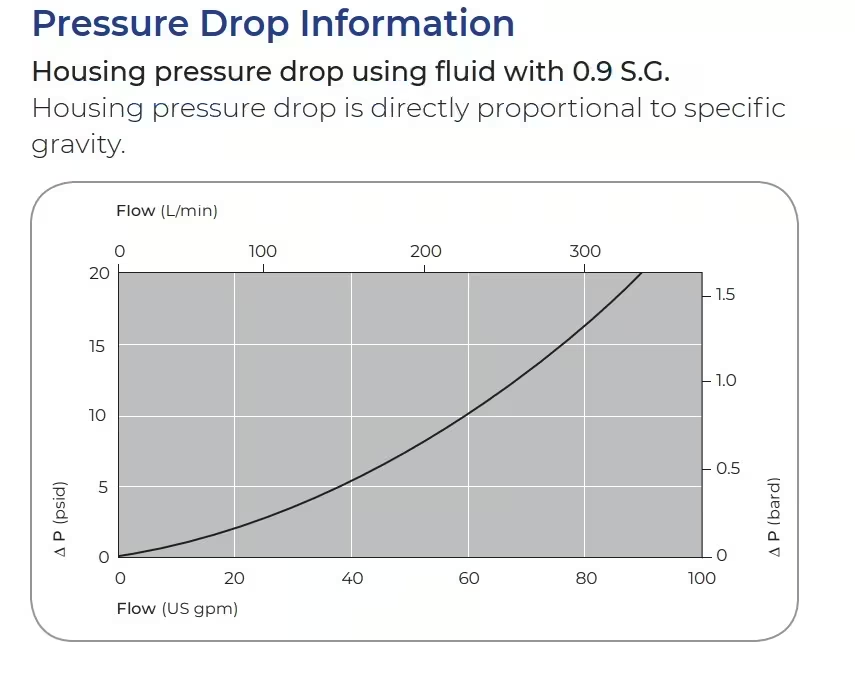
The vendor catalogue usually provides the information on the pressure drop for the filter in relation to the flow. The engineer has to check this and verify if that much pressure drop is allowable in the particular process.
STEP 8: Check the Filter Temperature range
Verify if the temperature range given for the filter is sustainable for your system.
STEP 9: Select Filter Housing Material
The filter housing material should be selected based on the process fluid, operating temperature, pressure and corrosion requirement. Carbon steel is commonly used for hydraulic oil, lubricating oil and other non-corrosive fluids, while stainless steel such as SS 304 or SS 316/316L is preferred for corrosive fluids, water and applications requiring better corrosion resistance. For highly corrosive chemicals, polypropylene (PP), PVDF or other non-metallic materials may be used where their pressure and temperature limits are suitable. Therefore, the housing material should always be checked for compatibility with the process fluid before selecting the filter.
Table 2 at the end of the article gives a general guideline for housing material selection. The final material should always be checked against the actual process fluid, concentration, operating temperature and pressure using the filter manufacturer’s compatibility data.
STEP 10: selecting other accessories
A differential pressure indicator is the watchdog of your filter housing. It continuously measures the pressure drop across the filter element — upstream versus downstream — and as the element loads with dirt, that drop steadily rises. Once it hits the set threshold (say 35 psi or 100 psi depending on the housing series), the indicator comes alive, giving operators a clear signal that it’s time to change the element before bypass occurs.
This filter offers several indicator options: a simple visual flag (A219D, 778N) that flips red/green when clogging happens, electrical switches (A218M, 861C, 771B) that send a remote alarm to your control system, a switch with LED lights (A218R) for both local and remote visibility, and even a thermal lockout visual (778N) that prevents false warnings during cold starts when oil viscosity is high. In short, the indicator is your early warning system, and choosing the right type ensures you catch filter clogging before it compromises your lubrication or hydraulic circuit.
For our system, we will connect the pressure tapping ports to a separate differential transmitter, and the transmitter will provide information to the UCP. So we have not chosen this option.
STEP 11: Select Filter certification
Filter housings are pressure equipment, and depending on where they’re installed, certain certifications are mandatory. In the EU, compliance with the Pressure Equipment Directive (PED) is required, often under SEP for smaller assemblies or higher categories for larger vessels. In the US, the governing code is the ASME Boiler and Pressure Vessel Code, with the ASME U‑Stamp marking applied to housings that qualify as pressure vessels. For Canada, every pressure vessel must carry a CRN (Canadian Registration Number), issued by provincial regulators. These certifications are the common language of safety and engineering integrity across regions. Engineers must check the certification requirement before procurement, because a housing without the right certification is simply not installable in that jurisdiction.
Since our filter housing is installed in Europe, we ordered PED compliance; and since we also may have projects in the US in future and since ASME is like a mandatory code, we also ordered the U-Stamp in this filter.
Table 1 below is for the common certifications required for filters around the regions.
| Region / Market | Certification | Key Notes |
| European Union (EU/EEA) | PED 2014/68/EU (Pressure Equipment Directive) | Mandatory for all pressure equipment >0.5 bar. Requires CE marking and conformity assessment by a Notified Body (e.g., TÜV, Bureau Veritas). |
| United States | ASME BPVC Section VIII, U‑Stamp | Required for pressure vessels. Independent Authorised Inspector verifies design, fabrication, and testing. Often paired with National Board Registration for traceability. |
| Canada | CRN (Canadian Registration Number) | Issued by provincial regulators. Each province must approve the design before installation. |
| Middle East (Saudi Arabia, UAE, Qatar) | ASME U‑Stamp widely accepted | Most refineries and petrochemical projects specify ASME BPVC. Some projects also require PED compliance for imported EU equipment. |
| Asia (India, China, SE Asia) | ASME U‑Stamp or PED depending on client | Indian Oil & Gas projects often specify ASME BPVC. Chinese projects may require local GB standards alongside ASME/PED. |
| Australia & New Zealand | AS 1210 (Australian Standard for Pressure Vessels) | Local compliance required, but ASME U‑Stamp vessels are often accepted with supplementary documentation. |
| South America (Brazil, Argentina) | NR‑13 (Brazilian pressure vessel regulation) + ASME/PED | NR‑13 is mandatory in Brazil, but international projects often demand ASME or PED certification too. |
Table 2 below gives a general guideline for housing material selection.
| Process fluid | housing material | Why used | Important note |
| Hydraulic oil | Carbon steel, SS 304/316 | Good mechanical strength and suitable for petroleum-based hydraulic oils | Check oil additives and seal compatibility |
| Lube/turbine oil | Carbon steel, SS 304/316 | Common for mineral-oil-based lubrication systems | For your gas-turbine example, metallic housing is normally appropriate; exact material is vendor/OEM dependent. |
| Diesel/fuel oil | Carbon steel, SS 304/316 | Good compatibility with hydrocarbon fuels and high mechanical strength | Check fuel composition and corrosion conditions |
| Natural gas/hydrocarbon service | Carbon steel, SS 304/316 | High pressure and mechanical strength | Material selection also depends strongly on water, H₂S and corrosion conditions. |
| Water – general industrial | Carbon steel, SS 304/316, PP for low-pressure service | Material depends mainly on water chemistry and corrosion requirement | Chlorides can make SS 304 unsuitable |
| Demineralised / DI water | SS 316/316L, PP | Good corrosion resistance and low contamination | PP is particularly used in lower-pressure applications |
| Seawater | Duplex stainless steel, super duplex, suitable corrosion-resistant alloys | High resistance to chloride corrosion | Ordinary carbon steel and 304 SS are generally not preferred for wetted surfaces. |
| Dilute acids | PP, PVDF, PTFE-lined construction, selected stainless/alloys depending on acid | Non-metallic materials can provide good chemical resistance | Exact acid concentration and temperature are critical |
| Strong/aggressive acids | PTFE/PFA/PVDF or special alloys | Better resistance to aggressive chemical attack | Must be checked against the exact chemical and concentration |
| Caustic / NaOH | PP, PVDF, SS 316 for suitable conditions | Good resistance depending on concentration and temperature | Concentration and temperature can change material suitability |
| Solvents | SS 316/316L, PTFE/PFA/PVDF depending on solvent | Stainless steel provides broad chemical resistance; fluoropolymers are used for aggressive solvents. | Do not assume PP is suitable for every solvent. |
| Ammonia | Carbon steel, SS 304/316 depending on service conditions | Metallic construction is widely used | Water content, pressure and temperature must be considered |
| Compressed air | Carbon steel, aluminium, SS | Mechanical strength and general corrosion considerations | Moisture and oil content affect material choice |
| Food/beverage | SS 304/316L | Cleanability, corrosion resistance and hygienic construction | 316L is often selected for more corrosive products |
| Pharmaceutical / high-purity water | SS 316L, PP, PVDF | Corrosion resistance and high-purity construction | Surface finish, extractables and sanitary design also matter |
| Chemical process liquids | SS 316L, PP, PVDF, PTFE-lined or special alloys | Depends heavily on chemical compatibility | Must be selected from the actual chemical composition |

Leave a Reply