
What is a gasket
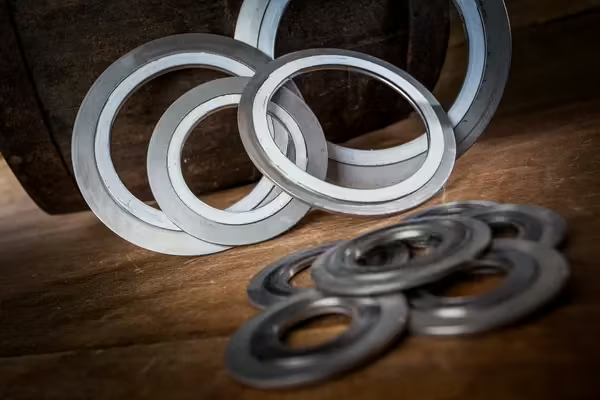
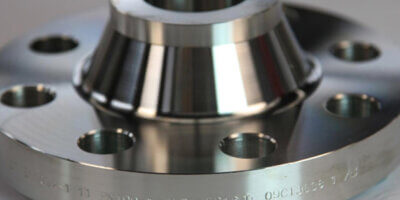
A gasket is a mechanical sealing element placed between two mating surfaces, i.e., flanges in the case of piping, to prevent leakage of fluids or gases. Gaskets are used because, in industrial piping systems, creating a perfectly leak-proof seal between two connecting metal surfaces is almost impossible.
How does the gasket prevent leakage
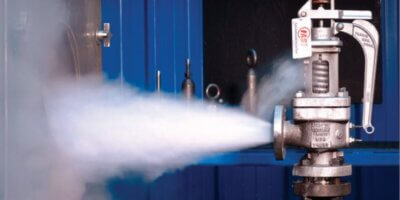
A gasket prevents leakage by filling the microscopic gaps between two flange faces that are never perfectly smooth. When bolts are tightened, the gasket compresses and flows into surface irregularities, blocking potential leak paths. It maintains sealing pressure greater than the internal fluid pressure, ensuring a tight and reliable joint.
Types of gaskets by material
Non-metallic/soft
Non-metallic gaskets are cut from a flat and soft sheet. They are used with flat-face mating flanges. Soft gaskets (non-metallic) are limited to low to medium pressure applications (ASME #150 flange class) and rarely specified for pressures above 20barg.
These are generally made of elastomers (natural and synthetic rubbers), Teflon (PTFE), flexible graphite, Compressed Non-Asbestos Fibre (CNAF), or rubber.
Asbestos was commonly used and termed compressed asbestos fiber (CAF) gaskets, but it was withdrawn from the industry because of health and safety norms.
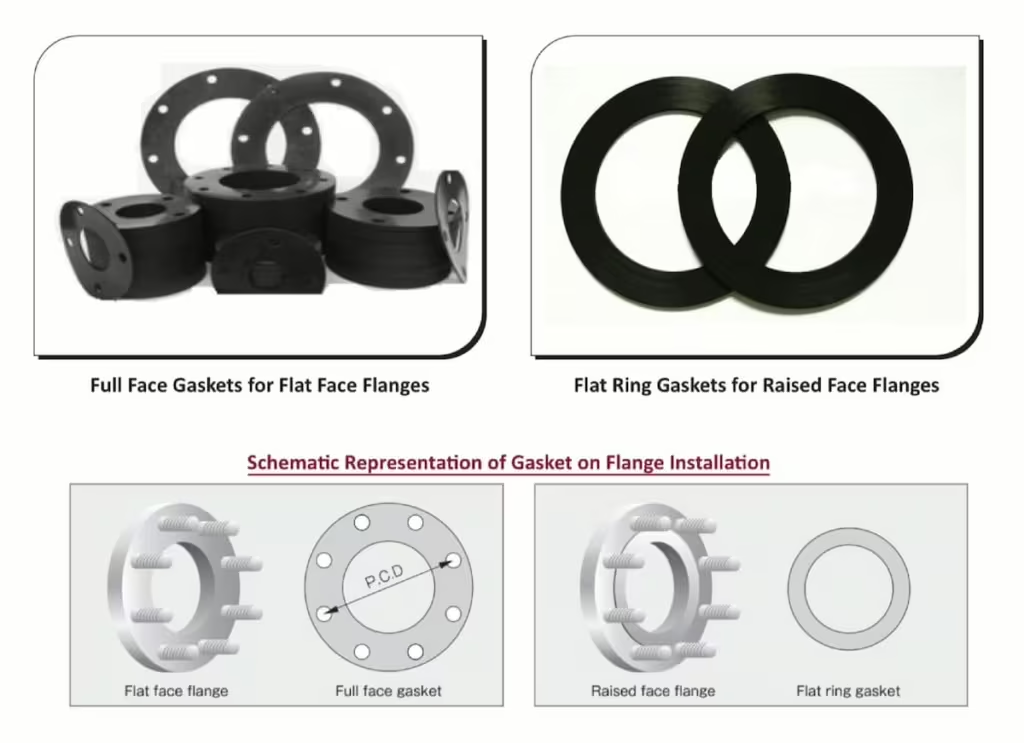
Full-face gaskets are installed between flat-face flanges and cover the entire flange surface, providing a uniform sealing area; flat-ring gaskets, by contrast, sit within the bolt circle and seal only the raised sealing surface, making them suitable for raised-face flanges where the outer flange face remains exposed.
Below is a table showing which type of non-metallic gasket is suitable for use with which flange facing. i.e Full face gasket for flat face flanges and flat ring gasket for raised face flanges.
Semi-metallic/Composite
Semi-metallic gaskets are made by combining metallic and non-metallic materials. The metal part provides strength and mechanical support, while the non-metallic part provides sealing ability. These gaskets are used across a wide pressure range, from ASME Class 150 up to Class 2500. Common types of semi-metallic gaskets include spiral wound, metal jacketed, camprofile (kamprofile), and metal-reinforced graphite gaskets.
Spiral wound gaskets
Among all the types, spiral wound gaskets are the most widely used, especially for raised face flanges. They consist of a preformed metal strip and a soft filler material wound together around a metal mandrel. The soft filler creates the seal between the flange faces, while the metal strip provides strength and resilience.
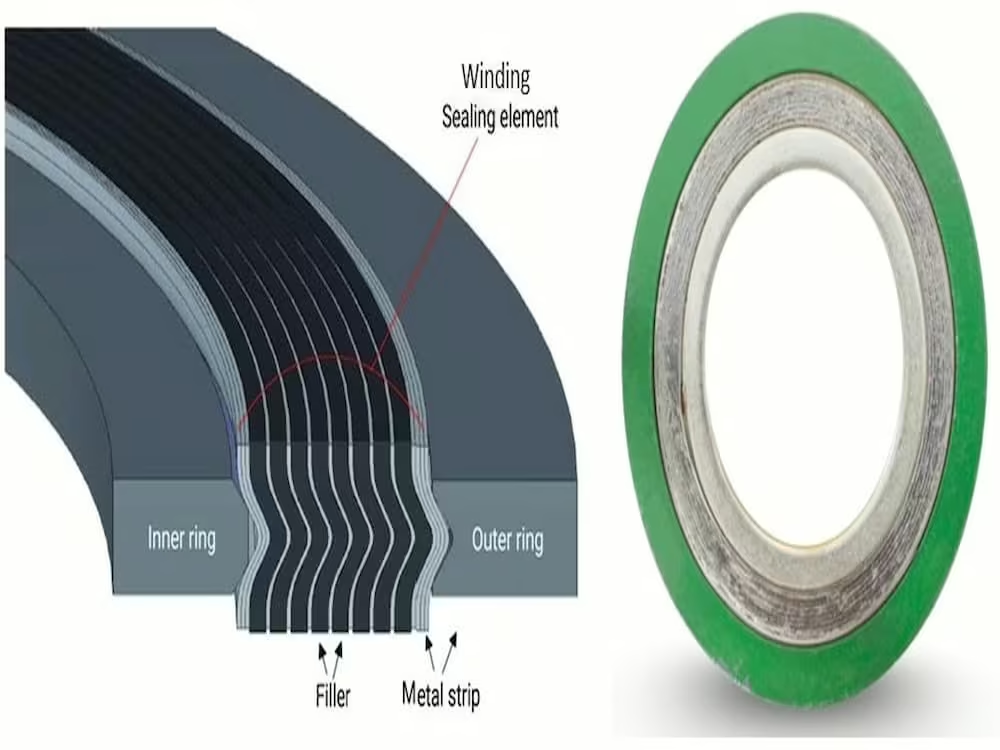
A spiral wound gasket consists of three main elements:
Outer Ring: Usually made of carbon steel/ stainless steel or alloys. It acts as a centering or guide ring that positions the gasket correctly in the flange and controls compression during bolt tightening.
Inner Ring: Prevents the gasket windings from buckling into the pipe and protects the sealing element from damage caused by process flow, it prevents the winding from entering the process flow. Normally made of SS304 for the most common general process services, SS 316 for corrosive or chemical environments, other alloys such as Alloy Steels (Monel, Inconel) are used for special or high-temperature services.
Sealing Element: Made of metal windings with filler material such as graphite or PTFE, which forms the seal and prevents leakage between the flange faces.
The filler material between the metal windings are important parameter and can be selected based on process temperature and corrosive properties.
| Filler Material | Max Temp (°C) | Max Op. Pres (Bar) | Best For |
| Graphite | 550 | 250 | High temperature, steam lines |
| PTFE | 260 | 100 | Corrosive chemicals |
| Mica-Graphite | 1000 | 250 | Extreme heat, oxidizing media |
| Non-Asbestos | 250 | 100 | Liquids & Gases applications |
The Metal winding material is to be selected to suit the process. Below is a recommended combination of winding material and filler material according to process media.
| Media Type | Recommended Gasket |
| Steam | SS 316 + Graphite |
| Hydrocarbons | SS 304 + PTFE |
| Acids (HCl) | Monel + PTFE |
| Alkalis | Inconel + Graphite |
Below is a brief on varieties of style commonly available for spiral wound gasket for different types of flanges
Style CG gasket consists of a sealing element with an outer metal ring that helps in proper positioning and prevents over-compression. It is suitable for raised and flat face flanges in mild to moderate service conditions.
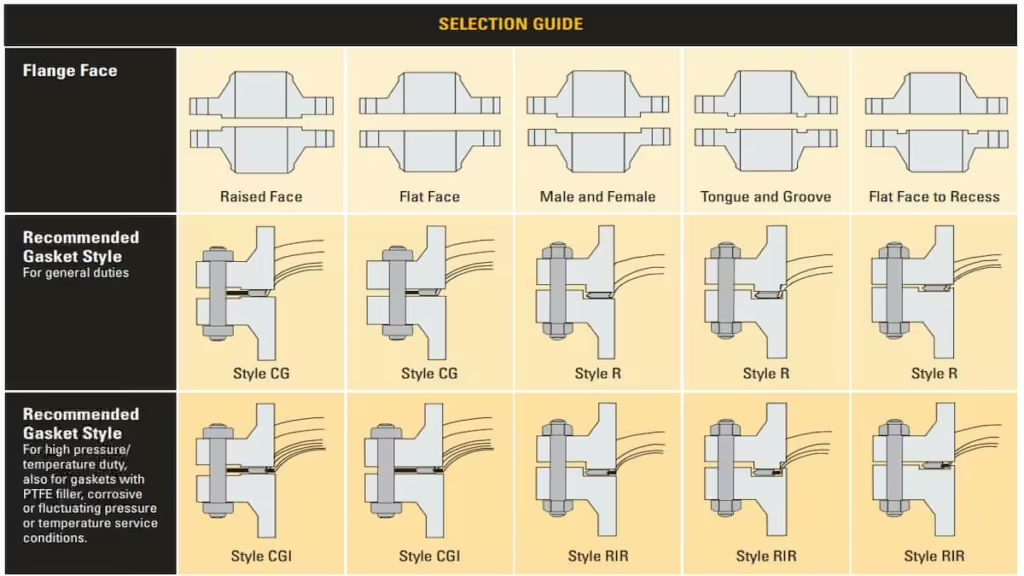
Style CGI gasket has both outer and inner metal rings, which control compression and prevent inward buckling of the sealing element. The inner ring also protects the gasket from heat and process fluid, making it suitable for moderate to severe service conditions.
Style R gasket consists of only a sealing element with extra metal windings at the start and end for better stability and sealing. Its compression is controlled by the flange face design, and it is mainly used with tongue and groove, male and female, or flat to groove flange connections.
Style RIR gasket consists of a sealing element with an inner metal ring that acts as a compression stop and protects the gasket from the process fluid. The inner ring also reduces turbulence and flange erosion, and it is mainly used with male and female (spigot and recess) flange connections.
A spiral wound gasket is called self-aligning because it has an outer centering ring that automatically positions the gasket correctly within the bolt circle. This prevents misalignment during installation and ensures uniform compression for proper sealing.
Metal jacketed gaskets
A metal jacketed gasket is a simple type of semi-metallic gasket that consists of a soft, compressible filler material enclosed inside a thin metallic outer jacket. When the flange bolts are tightened, the soft filler compresses and forces the metal jacket to deform slightly, allowing it to adapt to the flange surface and create a seal.
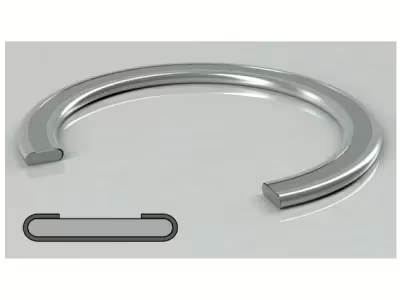
The metal jacket provides strength and protection, while the internal filler ensures proper sealing. Metal jacketed gaskets can be manufactured using different types of metals and high-temperature filler materials depending on the service conditions.
This inexpensive gasket arrangement is occasionally used on standard flange assemblies, valves, and pumps. Jacketed gaskets can be easily manufactured in different sizes and shapes, making them a cost-effective option for heat exchangers, shell flanges, channel covers, and similar joints. However, because the sealing surface is metallic, they are less forgiving to uneven flange finishes and are not ideal for applications with frequent temperature or pressure cycling.
Camprofile (kamprofile) gaskets
A camprofile gasket consists of a solid metal core, usually made of stainless steel, with concentric grooves machined on both sides. These grooves are covered with a thin sealing layer, which may be graphite, PTFE (Teflon), CAF, or even metal, depending on the service requirements.
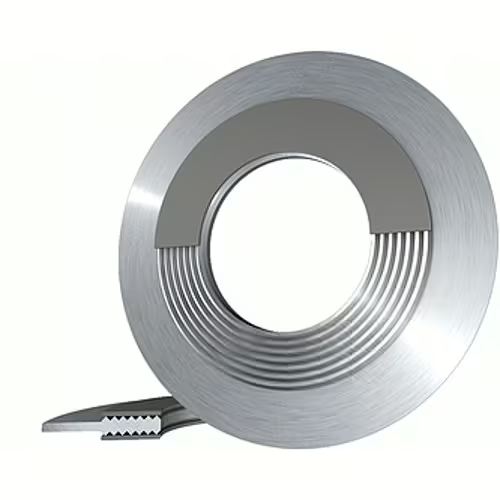
When the gasket is compressed between flanges, the grooved metal core provides strength and stability, while the soft sealing layer fills surface irregularities to create an effective seal. Camprofile gaskets are suitable for a wide range of pressure and temperature applications and offer good performance in demanding services.
Camprofile gaskets are commonly used in refineries, power plants, and critical piping flanges in pressure classes from class 150 to class 2500, where repeated maintenance and reliable sealing are important.
metal-reinforced graphite gaskets
Metal reinforced gaskets are high-performance sealing solutions featuring a rigid metal core (often 316L Stainless Steel, 1/8″ thick) sandwiched between soft sealing materials, typically flexible graphite or PTFE.
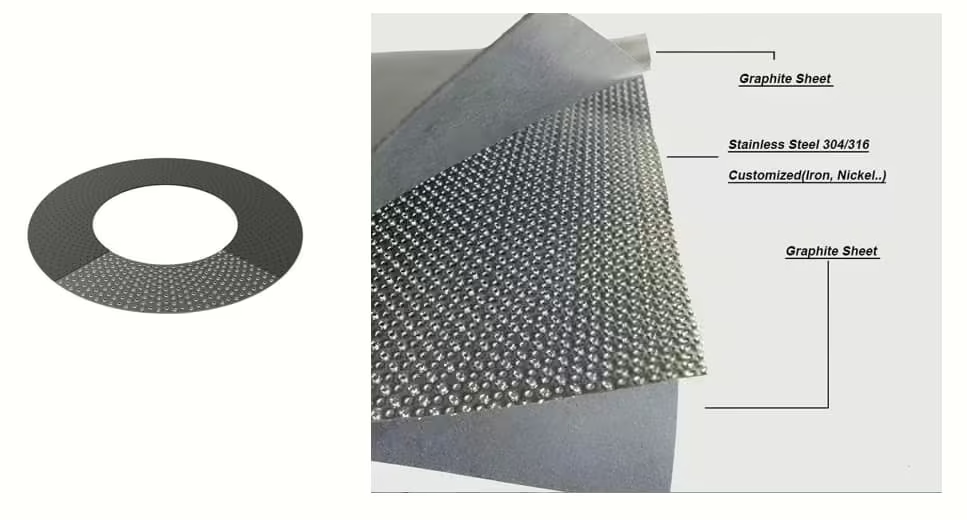
are used for high-temperature, high-pressure, and highly corrosive sealing applications. They are used in pipe flanges, valves, pumps, pressure vessels, heat exchangers, and automotive exhaust/cylinder systems.
Metallic/Hard
Metallic gaskets are made from a single grade of metal and manufactured to a specific size and shape. The most used metallic gasket in the process industry is the ring-type joint (RTJ), for very high pressures (Class 1500 and above), ring-type joint (RTJ) gaskets are more commonly used. It is also suitable for very high pressure (>5000 psi) and high temperature applications. They create a metal-to-metal, self-energized seal within specialized flange grooves, offering superior resistance to blowout and leak-proof performance compared to the semi-metallic construction of spiral wound gaskets.
Ring Joint Gaskets
RTJ (Ring Type Joint) gaskets are metallic rings designed to fit into machined grooves on RTJ flanges. When bolted, the metal ring deforms slightly within the groove to create a strong and reliable seal under high-pressure and temperature conditions.
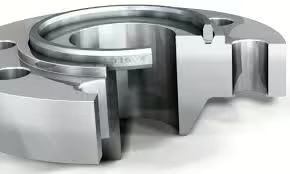
RTJ gaskets are best suited for grooved RTJ flanges commonly used in high-pressure services such as oil and gas and steam applications. Ring-type joint (RTJ) gaskets are manufactured as per ASME B16.20 and are used with flanges designed according to ASME B16.5 and ASME B16.47 standards. In oil and gas applications, the API 6A standard covers both the flanges and their matching RTJ gaskets.
RTJ gaskets are mainly of three types
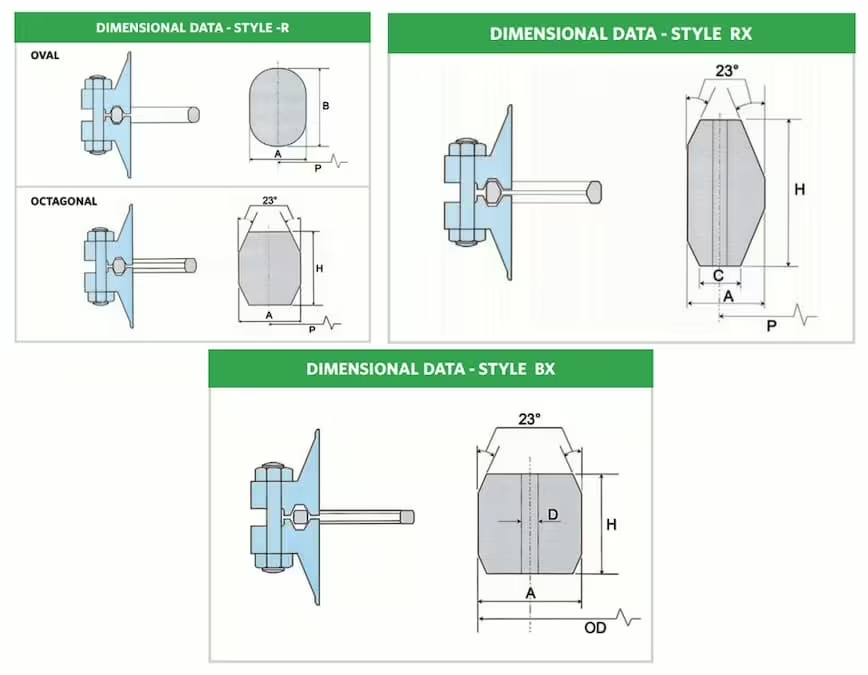
Style R – These are manufactured in accordance with ASME B16.20 or API 6A. Available in both oval and octagonal configurations, both types are interchangeable on the modern octagonal type, with grooved flanges
Style RX – Style RX is a modified version of the standard Style R ring-type joint gasket. It fits in the same flange groove as Style R, so they are interchangeable, but the final tightening distance may differ slightly. The special shape of the RX gasket creates a pressure-energizing effect when the system is pressurized, which improves the sealing performance.
Style BX – Style BX pressure-energized ring type joint (RTJ) gaskets are manufactured as per ASME B16.20, API 6A, and API 17D standards. They are designed for API 6BX flanges used in very high-pressure systems up to 20,000 psi. When properly installed, the BX gasket allows almost face-to-face contact between flange faces, meaning the gasket is fully confined on both inner and outer diameters. Each BX gasket also has a pressure balance hole to equalize any pressure trapped in the groove.
Types of gaskets by Configuration
Full Face
Full Face gaskets cover the entire flange surface including the bolt holes, which helps distribute the bolt load evenly and provides full surface sealing. They also protect the flange face from corrosion and fluid exposure. This type of gasket is best suited for flat face (FF) flanges and is commonly used in low-pressure applications such as water and utility lines.
IBC (Inner Bolt Circle)
IBC (Inner Bolt Circle) gaskets fit within the bolt circle and seal only the raised sealing portion of the flange. They require proper and uniform bolt tightening to achieve effective sealing on the raised face area. IBC gaskets are best suited for raised face (RF) flanges and are widely used in process and plant piping systems.
RTJ (Ring Type Joint)
Ring Type Joint (RTJ) gaskets are precision-machined metallic rings that fit into the grooved faces of RTJ flanges to create a metal-to-metal seal under high bolt load. RTJ gaskets are covered in the previous paragraph under metallic gaskets.
Which standards to follow for gaskets
Non-metallic gaskets shall conform to B16.21 (corresponding to B16.5) up to 24″, and B16.21 (corresponding to B16.47B) beyond 24″, unless otherwise specified.
Spiral wound gaskets and Ring Joint gaskets shall conform to B16.20.
API 6A, Specification for Wellhead and Christmas Tree Equipment.
Gasket dimensions are covered in ASME B16.5 up to NPS 24″ and in ASME B16.47 Series A and B for NPS 26″ and above.
Gasket selection
based on flange face
| Flange face | Type of gasket | Category |
| Flat face | Full face gasket | Non-metallic |
| Raised face (low-pressure application) | Flat ring gasket | Non-metallic |
| Raised face (low to high pressure application) | Spiral wound gasket | Semi-metallic |
| Male and female face flange | Spiral wound gasket (Type R/RIR) | Semi-metallic |
| Toung and groove | Spiral wound gasket (Type R/RIR) | Semi-metallic |
| Ring-type flange | Ring gasket | Metallic |
Based on pressure temperature rating
Refer to Table below for the pressure/temperature rating of some commonly used gasket materials.
| Gasket Material | Maximum Pressure | Temperature |
| Nitrile (NBR, Buna-N) | 150 psi | -20°F to 250°F |
| Neoprene (35 IRHD, 60 IRHD, 75 IRHD) | 150 psi | -20°F to 212°F |
| EPDM (70 IRHD) | 150 psi | -20°F to 350°F |
| Graphite | 2000 psi | -300°F to 850°F |
| Viton (60 IRHD, 80 IRHD) | 150 psi | -20°F to 392°F |
| Reinforced Teflon | 800 psi | -350°F to 550°F |
| NBR/Synthetic Fiber (Inorganic Fiber) | 1200 psi | -40°F to 550°F |
| EPDM/Aramid Fiber | 1200 psi | -40°F to 550°F |
| NBR/Aramid Fiber | 1200 psi | -40°F to 550°F |
| SBR/Aramid Fiber | 1200 psi | -40°F to 550°F |
| Spiral Wound – Teflon | Class 2500 | -350°F to 500°F |
| Spiral Wound – Graphite | Class 2500 | -300°F to 850°F |
| Flange Pressure Class (ASME B16.5) | Typical Temperature Range | Recommended Gasket Type | Typical Flange Face | Remarks |
| Class 150 | Low to Moderate (up to ~200–250°C) | Flat Face / Soft Gasket (CAF, PTFE, Graphite) | Flat Face (FF) or Raised Face (RF) | Used in low pressure utilities, water, air, low temperature services |
| Class 150 | Low to Moderate (up to ~200–250°C) | Spiral Wound Gasket | Raised Face (RF) | Used in low to moderate pressure applications |
| Class 300 | Moderate (up to ~400°C) | Spiral Wound Gasket | Raised Face (RF) | Most common gasket in process plants |
| Class 400 | Moderate to High | Spiral Wound Gasket | Raised Face (RF) | Used where higher pressure sealing is needed |
| Class 600 | High (up to ~500°C depending on material) | Spiral Wound Gasket | Raised Face (RF) | Typical refinery and hydrocarbon service |
| Class 900 | High Pressure & Temperature | Ring Type Joint (RTJ) | RTJ Face | Metal to metal sealing for severe service |
| Class 1500 | Very High Pressure | Ring Type Joint (RTJ) | RTJ Face | Used in critical oil & gas systems |
| Class 2500 | Extreme Pressure / Temperature | Ring Type Joint (RTJ) | RTJ Face | High pressure wellhead & subsea systems |
References:
Peter Smith, 2007, The fundamental of piping design, Gulf Publishing Company Houston

Leave a Reply