
The analysis of piping under pressure, weight, and thermal expansion is complex. This complexity can be understood by knowledge of the Principal Axis System.
Stress is considered as the ratio of Force to Area.
Stress=\frac{Force}{Area}To find the stress in the small element, say a cube of a piece of pipe, construct a three-dimensional, mutually perpendicular principal axis system with each axis perpendicular to the face of the cube it intersects.
Each force acting on the cube can be resolved into force components acting along each of the axes. Each force acting on the face of the cube divided by the area of the cube face is called the principal stress.
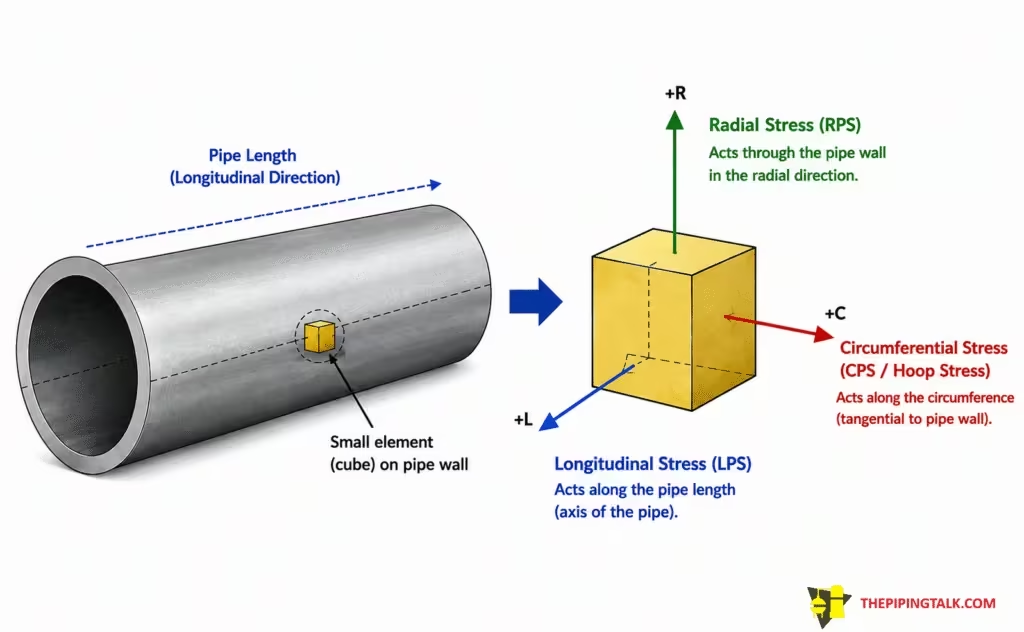
The principal stress acting along the centerline of the pipe is called Longitudinal principal stress. This stress is caused by longitudinal bending, axial force loading, or pressure.
Radial principal stress acts on a line from the center of the pipe through the pipe wall. This stress is compressive stress acting on the pipe’s inside diameter caused by internal pressure or a tensile stress caused by vacuum pressure.
Circumferential principal stress, sometimes called Hoop or tangential stress, acts along the circumference of the pipe. This stress tends to open up the pipe wall and is caused by internal pressure.
When two or more principal stresses act at a point on a pipe, a shear stress will be generated.
Longitudinal Principal stress, LPS =\frac{PD}{4T}\\
Circumferential Principal stress, CPS (Hoop) = \frac{PD}{2T}\\
Radial Principal stress, RS = PFailure Theories
The Code presents equations for determining the stress levels in a piping system & provides stress limits for comparison. These theories are the maximum principal stress failure theory & maximum shear stress failure theory & Von Mises Failure Theory.
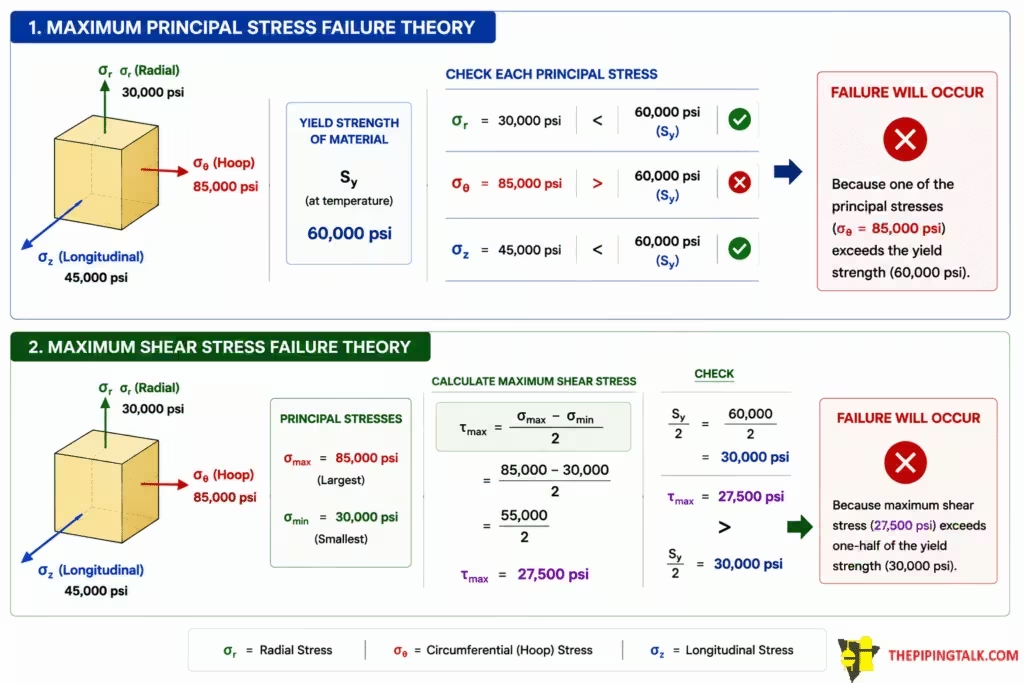
The maximum principal stress failure theory by Rankine
The maximum principal stress failure theory states that when any one of the three mutually perpendicular principal stresses exceeds the yield strength of the material at temperature, failure will occur.
The maximum shear failure theory- by Tresca
The maximum shear failure theory states that when the maximum shear stress (arithmetic average of largest minus smallest principal stresses) exceeds one-half the yield strength of the material at temperature, failure will occur.
Von Mises Failure Theory
Another widely used failure criterion is the Von Mises theory. Imagine a cube where the stresses are different in different directions—say, high hoop stress, lower longitudinal stress, and radial stress. The cube gets stretched more in one direction than another, so its shape changes or distorts. This difference in the stresses creates distortion energy. Von Mises theory is based on this distortion energy.
The Von Mises failure theory states that failure will occur when the Von Mises equivalent stress, which represents the combined effect of the three principal stresses based on distortion energy, exceeds the yield strength of the material at temperature. It is essentially a prediction of the shape-changing effect produced by three principal stresses.
\sigma_{vm} = \sqrt{\frac{(\sigma_1-\sigma_2)^2+(\sigma_2-\sigma_3)^2+(\sigma_3-\sigma_1)^2}{2}}\\
\\
\sigma_{vm} \leq S_y\\
\\
\sigma_{vm} > S_y\\
\\

\text{Where } \sigma_{vm} = \text{Von mises equivalent stress  } \\
S_y= \text{Yield strength of material  }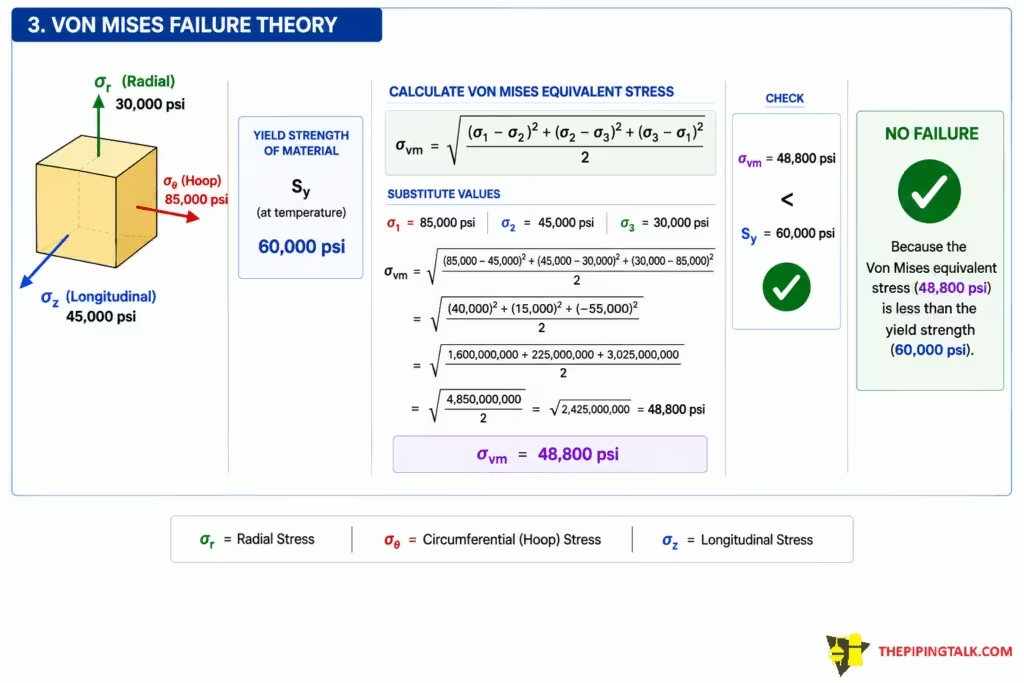
The maximum principal stress failure theory by Rankine vs. the maximum shear failure theory by Tresca vs. the Von Mises Failure Theory
The three theories approach the same problem from different directions. Rankine looks at the maximum principal stress and asks whether any principal stress has exceeded the material yield strength. Tresca looks at the maximum shear stress and is based on the difference between the largest and smallest principal stresses. Von Mises considers the combined distortion energy produced by the principal stresses.
For ductile metallic materials, Tresca and Von Mises are commonly used yield criteria in engineering analysis. In the case of widely used piping stress software CAESAR II, CAESAR II provides two yield-stress criteria for calculating the maximum stress state: Maximum Shear Stress (Tresca) and Von Mises (Maximum Energy of Distortion). The default configuration is Maximum Shear Stress (Max3D Shear). These yield-criterion results should not be confused with the code stress calculated for piping-code compliance, which is determined using the equations and requirements of the selected piping code, such as ASME B31.3.



Leave a Reply