

What is a valve flow coefficient (Cv)
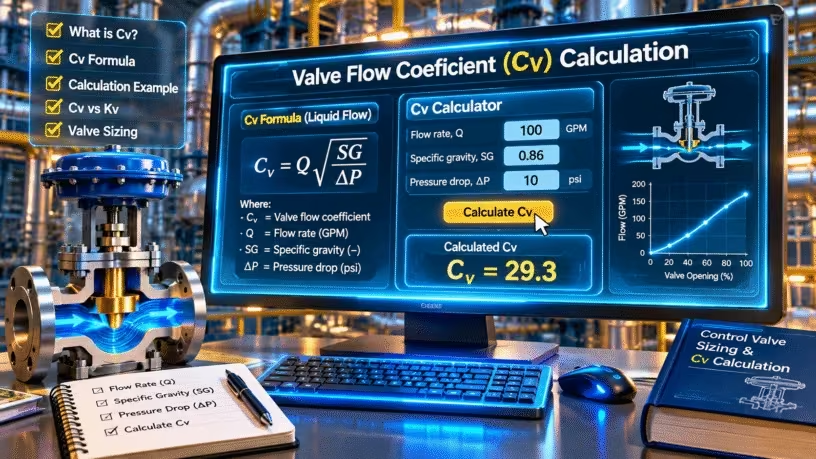
The valve flow coefficient (Cv) is the flow coefficient of the valve. It is the no of U.S. gallons of water that can flow through a valve with a 1 psi pressure drop at 60 °F for 1 minute.
The Valve Flow Coefficient (Cv) indicates the flow capacity of a valve. A higher Cv value means the valve can pass a higher flow rate at a given pressure drop, indicating lower resistance to flow. Conversely, a lower Cv value indicates lower flow capacity and greater resistance to flow.
Why is the valve flow coefficient (Cv) needed
- To compare different valves: Since the valve coefficient (Cv) has standardized parameters (U.S. gpm at 1 psi pressure drop @ 60 °F), when you have the Cv value for 2 different valves, you can actually compare the flow capacity and pressure drop for a certain flow rate for both valves.
- For Valve sizing: you can calculate the Cv required for your flow and pressure drop parameters and know what size of the valve will be best suited for it.
Valve flow coefficient (Cv) formulae for incompressible flows
C_v = Q \times \sqrt{\frac{SG}{\Delta P}}
\begin{aligned}
Where,
Q &= \text{Flow rate (gallons per minute)}\\
C_v &= \text{Valve flow coefficient}\\
\Delta P &= \text{Pressure drop (psi)}\\
SG &= \text{Specific gravity (water = 1)}
\end{aligned}- Use our Valve Cv calculator
- Use our Flow rate calculator from Cv
- Use our pressure drop calculator from Cv
How to calculate Cv with an example
We will do a sample calculation to find the required valve flow coefficient (Cv), and below are the information we have
- Required flow rate = 100 GPM
- Specific gravity = 0.86
- Upstream pressure = 50 psi
- Downstream pressure = 40 psi
Step 1: Calculate the pressure drop
\begin{aligned}
\Delta P &= P_1-P_2\\[6pt]
\Delta P &= 50-40=10\text{ psi}
\end{aligned}
If the pressure drop across the valve is not known, check what is the total allowable pressure drop you have including the valve. Once you determine that, the rule of thumb is that, the valve should be designed to use 10-15% of the total pressure drop or 10 psi, whichever is greater.
Suppose 120 psi is the allowable pressure drop. Then 10% of the total pressure drop is 12 psi, which is greater than 10 psi, so we can take 12 psi as the maximum pressure drop across the valve and proceed to find the Cv value with it.
Step 2: Calculate the required Cv
The liquid flow equation is
C_v = Q \times \sqrt{\frac{SG}{\Delta P}}Substituting the values
C_v = 100 \sqrt{\frac{0.86}{10}}  \\[10pt]


\boxed{C_v = 29.33}
This means the valve must have a flow capacity of at least Cv of 29.33 to pass 100 GPM under the specified pressure drop, subject to applicable installation and flow condition.
Step 3: How to Select a Valve Using Calculated Cv
Once the required Cv is calculated, the next step is to select a suitable valve. Valve manufacturers provide Cv values for different valve sizes and types in their technical datasheets or flow coefficient tables.
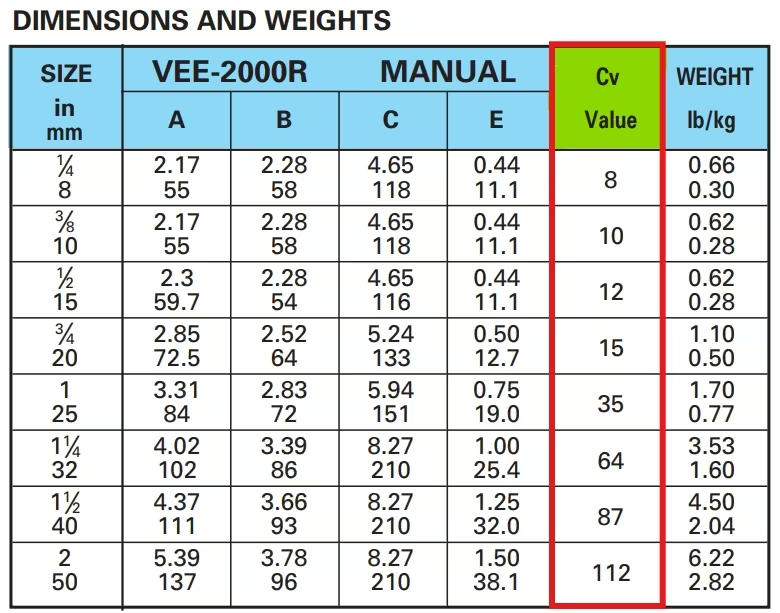
Compare the calculated Cv with the manufacturer’s rated Cv. For example, if the required Cv is 30 and the available valves have rated Cv values of 25, 40, and 60, the valve with a rated Cv of 40 can be considered. The selected valve should have sufficient flow capacity to meet the required flow rate without exceeding the allowable pressure drop.
However, Cv alone should not be the only selection criterion. The valve size, pressure rating, temperature rating, material compatibility, and operating conditions should also be checked. For control valves, the required valve opening and controllability must also be considered.
What Other Values Can Be Calculated Using Cv?
The Cv equation has three main variables: flow rate (Q), pressure drop (ΔP), and valve flow coefficient (Cv). If any two values are known, the third can be calculated, provided the specific gravity of the liquid is known. For example, if Cv and flow rate are known, we can calculate the pressure drop across the valve. Similarly, if Cv and pressure drop are known, we can calculate the flow rate.
\begin{aligned}
&\text{The basic liquid flow equation is:} \\[10pt]
&\boxed{C_v = Q\sqrt{\frac{SG}{\Delta P}}} \\[20pt]
&\text{By rearranging this equation, we get:} \\[20pt]
&\textbf{1. To calculate flow rate (Q):} \\[10pt]
&\boxed{Q = C_v\sqrt{\frac{\Delta P}{SG}}} \\[20pt]
&\textbf{2. To calculate pressure drop }(\boldsymbol{\Delta P})\textbf{:} \\[10pt]
&\boxed{\Delta P = SG\left(\frac{Q}{C_v}\right)^2}
\end{aligned}
What is Kv
Kv (metric valve flow coefficient) is a measure of the flow capacity of a valve. It is defined as the volume of water, in cubic metres per hour (m³/h), that flows through a valve with a pressure drop of 1 bar across it, under specified reference conditions. The reference water temperature is generally taken as 5°C to 40°C, depending on the applicable standard. Kv is commonly used in European valve specifications, whereas Cv is commonly used in the US.
How to calculate Kv
The Kv value is calculated using the following equation for liquid flow
K_v = Q\sqrt{\frac{SG}{\Delta P}}\\[10pt]
\begin{aligned}
&\text{Where:} \\[10pt]
&K_v = \text{Metric valve flow coefficient}\\[10pt]
&Q = \text{Flow rate (m}^3\text{/h)}\\[10pt]
&SG = \text{Specific gravity of the liquid relative to water}\\[10pt]
&\Delta P = \text{Pressure drop across the valve (bar)}
\end{aligned}
How to convert Cv and Kv
The following conversion factor can be used to interchange between Cv and Kv.
\begin{aligned}
K_v &= 0.865 C_v \\[10pt]
C_v &= 1.156 K_v
\end{aligned}
How the Cv formula is derived
The Cv formula is derived from the Bernoulli equation for the principle of conservation of energy.
\boxed{\frac{P}{\rho g}+\frac{v^2}{2g}+z=\text{Constant}} \\[10pt]
\begin{aligned}
Where,
P &= \text{Fluid pressure (Pa)}\\
\rho &= \text{Fluid density (kg/m}^3\text{)}\\
g &= \text{Acceleration due to gravity (m/s}^2\text{)}\\
v &= \text{Fluid velocity (m/s)}\\
z &= \text{Elevation above the reference level (m)}
\end{aligned}
Applying Bernoulli’s equation between two points horizontal pipe wit restriction. The elevation cancels out and we get
\frac{P_1}{\rho g}+\frac{v_1^2}{2g}
=
\frac{P_2}{\rho g}+\frac{v_2^2}{2g} \\[10pt]

\text{Rearranging}\\[10pt]
P_1-P_2=\frac{\rho}{2}\left(v_2^2-v_1^2\right)\\[10pt]

\Delta P = \frac{1}{2}\rho v^2\\[10pt]
\begin{aligned}
Where \: \Delta P &= \text{Pressure drop}\\
\rho &= \text{Fluid density}\\
v &= \text{Fluid velocity}
\end{aligned}
Rearranging\\[10pt]
v = \sqrt{\frac{2\Delta P}{\rho}}\\[10pt]
\text{The volumetric flow rate is Q=Av}\\\\[10pt]
\text{where A = area }\\\\[10pt]
\text{substituting the velocity in the equation}\\\\[10pt]
Q = A\sqrt{\frac{2\Delta P}{\rho}}
However, actual flow through a valve is affected by turbulence, friction and changes in flow direction. These effects are accounted for by introducing a discharge coefficient Cd.
\begin{aligned}
Q &= C_d A \sqrt{\frac{2\Delta P}{\rho}} \\[10pt]
\\[10pt]
\text{Rearranging:} \\[10pt]
Q &= \left(C_d A \sqrt{\frac{2}{\rho}}\right)\sqrt{\Delta P}
\end{aligned}
The term inside the brackets represents the flow capacity of the valve. Since it depends on the valve geometry and its internal flow characteristics, it is combined into a single coefficient called the Valve Flow Coefficient (Cv).
Thus, the simplified relationship becomes
Q = C_v \sqrt{\frac{\Delta P}{SG}}
Leave a Reply